

Hey there! As a supplier of wardrobe black storage racks, I've seen firsthand how important it is to get the measurements right. A well - measured storage rack not only fits perfectly in your space but also maximizes storage efficiency. So, let's dive into how you can measure for a wardrobe black storage rack.
1. Measure the Available Space
The very first step is to figure out how much space you've got. Start with the height. Use a tape measure to measure from the floor to the ceiling where you plan to put the rack. Make sure to measure at multiple points because sometimes, the ceiling might not be perfectly level. For instance, if there's a sloped ceiling or some unevenness, you'll want to know the lowest point so that your rack doesn't end up being too tall.
Next up is the width. Measure the distance between the two walls or the area where the sides of the rack will rest. Again, measure at different heights and points. Sometimes, walls can be a bit bowed or not completely straight. You don't want to buy a rack that's too wide and won't fit in the space.
Finally, measure the depth. This is the distance from the front to the back of the area. You need to consider what you'll be storing on the rack. If you're planning to store long - hanging clothes or large boxes, you'll need more depth.
2. Consider Your Storage Needs
Think about what you're going to put on the rack. If it's mainly clothes, you'll need to account for the length of the hangers and the clothes themselves. Most standard hangers are about 17 - 18 inches wide. So, you'll want to make sure that the rack has enough space between the bars for the hangers to hang freely without rubbing against each other.
If you're storing folded clothes, you can have smaller shelves. A good rule of thumb is to have shelves that are about 12 - 16 inches deep for folded clothes. This gives you enough space to stack the clothes neatly.
For storing shoes, you'll need shelves that are at least 8 - 10 inches deep. And if you have high - heeled shoes or boots, you might need adjustable shelves or a taller section of the rack to accommodate them.
3. Think About Accessibility
You also need to think about how you'll access the items on the rack. If you have a lot of items that you use frequently, you'll want to make sure that they're easy to reach. For example, if you're storing your daily - use clothes, you might want to have a lower section of the rack for them.
On the other hand, if you're storing seasonal items or things that you don't use often, you can put them on the higher shelves.
4. Check for Obstructions
Look around the area where you're going to place the rack. Are there any electrical outlets, light switches, or pipes that could get in the way? You need to make sure that the rack won't block these things. If there are obstructions, you might need to adjust your measurements or choose a different design of the rack.

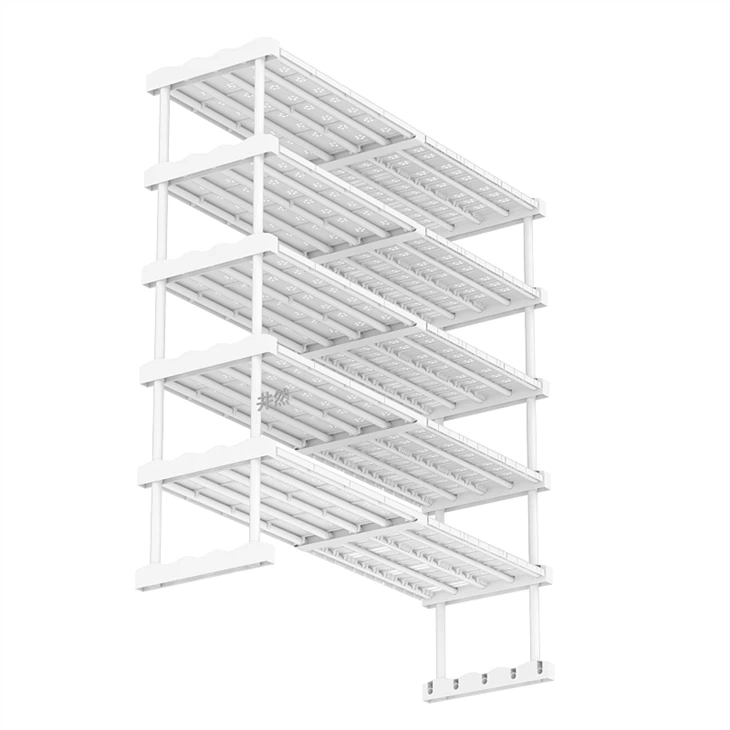
5. Look at the Rack's Design
Different racks have different designs, and this can affect the measurements. For example, some racks have a fixed number of shelves, while others are adjustable. Adjustable shelves give you more flexibility in terms of how you use the space.
If you're considering a 5 - Layer Expandable Small Shelf, it's great for small spaces where you might need to adjust the size later. The expandable feature allows you to make it wider or narrower depending on your needs.
A Corner Rack Ind Omitable is a great option if you have a corner space. When measuring for a corner rack, you'll need to measure the angle of the corner accurately. Most corners are 90 degrees, but sometimes, they can be a bit off.
For a Storage Room Storage Shelves, you can usually have more flexibility in terms of size. But you still need to make sure that it fits in the storage room and that you can move around easily to access the items.
6. Account for Assembly
Don't forget to account for the space needed for assembly. Some racks come in parts and need to be assembled on - site. You'll need enough space to lay out the parts and put the rack together. Make sure that there's enough clearance around the area so that you can move freely while assembling the rack.
7. Double - Check Your Measurements
Once you've taken all the measurements, double - check them. It's easy to make a mistake, especially if you're in a hurry. Measure everything at least twice to make sure that you have accurate numbers.
If possible, draw a rough sketch of the area and mark down the measurements. This can help you visualize how the rack will fit in the space and make it easier to compare different rack options.
8. Consult with an Expert
If you're still not sure about the measurements or which rack is the best for your needs, don't hesitate to consult with an expert. As a wardrobe black storage rack supplier, I'm always happy to help customers figure out the right measurements and choose the best rack for their space.
We have a wide range of racks in different sizes, styles, and materials. Whether you need a small, compact rack for a closet or a large, heavy - duty rack for a storage room, we've got you covered.
If you're interested in our products and want to discuss your specific requirements, feel free to reach out. We can work together to ensure that you get the perfect wardrobe black storage rack for your needs. Let's make your storage space more organized and efficient!
References
- General knowledge of storage rack design and measurement
- Industry standards for wardrobe and storage solutions